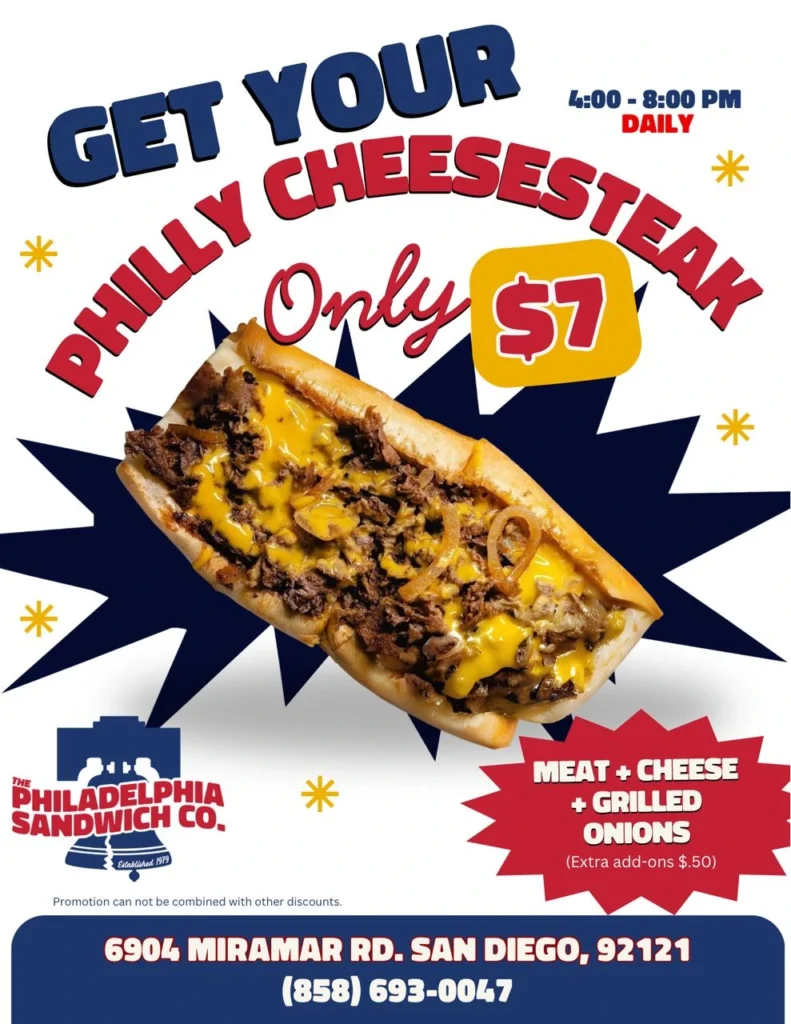
Order authentic Philly Cheesesteak with us! We offer catering & delivery! Please call: 858-693-0047 for orders!


A traditional Philadelphia cheesesteak does not include a separate sauce. The melted cheese — typically provolone, American cheese, or Cheez Whiz — combines with the natural juices of thinly sliced ribeye steak to create the moisture and richness people associate with “sauce.” Authentic Philly cheesesteaks rely on beef, cheese, onions, and a hoagie roll without additional condiments.
Few topics in cheesesteak culture create as much confusion as this one. Outside of Philadelphia, menus often list garlic aioli, chipotle mayo, barbecue sauce, ranch dressing, and specialty spreads as standard additions. Many customers assume those elements are part of the original formula. In reality, they are not.
The traditional Philly cheesesteak was never built around a separate sauce. It was designed around balance — high-quality beef, properly melted cheese, and bread that holds everything together without becoming soggy. When those elements are executed correctly, the sandwich produces its own richness.
Understanding this distinction is critical if you care about authenticity.
The cheesesteak originated in Philadelphia in the early 20th century as a simple grilled beef sandwich served on a long roll. Cheese was added later, but the structure remained minimalist. There were no complex condiments layered into the build.
The sandwich was developed for speed and practicality. It was cooked quickly on a flat-top grill, assembled immediately, and served hot. The cooking method mattered more than the ingredient count.
Simplicity became part of its identity.
Many people associate creamy texture with added sauce. When they bite into a well-made cheesesteak and experience a smooth, cohesive filling, they assume a hidden condiment must be responsible.
In reality, that texture comes from:
Rendered ribeye fat
Melted cheese integration
High-heat flat-top cooking
Proper chopping technique
When ribeye is sliced thin and cooked quickly, its intramuscular fat melts and coats the meat. When cheese melts into that hot beef, the two blend naturally. The result feels saucy — but it isn’t.
It’s simply beef and cheese behaving correctly.
In an authentic cheesesteak, cheese is not just a topping. It performs the structural and textural role that sauce plays in other sandwiches.
Provolone melts into a smooth, slightly sharp layer that coats the chopped beef evenly. American cheese integrates rapidly and creates a creamy texture without overpowering flavor. Cheez Whiz, often considered the most iconic option, spreads like a sauce but is still cheese — not a separate condiment.
In each case, the cheese binds the meat and distributes moisture across the sandwich. It creates cohesion rather than layering.
That cohesion is the defining feature of a true cheesesteak.
The interaction between beef and cheese is not accidental. It’s chemical.
Ribeye contains intramuscular fat that begins rendering at relatively low temperatures. When exposed to high heat on a flat-top grill, that fat melts and disperses throughout the chopped meat. Cheese, when melted over hot beef, blends with that rendered fat.
This creates a naturally creamy mixture. The fat carries flavor. The cheese binds texture. The bread absorbs just enough moisture to remain sturdy while still holding richness.
This is why properly made cheesesteaks do not feel dry — and why they do not require additional sauce.
A hoagie roll is designed to support hot beef and melted cheese. It has a slightly crisp exterior and soft interior that absorbs juices without collapsing.
When heavy sauces are introduced, the moisture balance shifts. Excess liquid can overwhelm the bread, causing sogginess. Instead of a cohesive bite, the sandwich becomes messy and unstable.
Authentic cheesesteaks prioritize structural integrity. That’s part of their design.
Below is a direct comparison between traditional Philadelphia cheesesteaks and modern variations often seen outside the region.
| Feature | Traditional Philly Cheesesteak | Modern / Fusion Cheesesteak |
|---|---|---|
| Primary “Sauce” | Melted cheese (Provolone, American, or Whiz) | Garlic mayo, chipotle aioli, BBQ sauce, ranch, etc. |
| Flavor Focus | Beef-forward with balanced cheese | Sauce-forward or flavor-layered |
| Texture | Cohesive, chopped, integrated | Layered or heavily coated |
| Authenticity Level | Traditional Philadelphia style | Regional reinterpretation |
| Structural Stability | Balanced moisture, stable roll | Higher risk of sogginess |
There are scenarios where adding a light condiment may align with personal taste preferences.
For example, leaner cuts of beef lack ribeye’s natural fat and may benefit from added moisture. Chicken cheesesteaks, which use poultry instead of marbled beef, often incorporate mild spreads to compensate for lower fat content.
Signature sandwiches or specialty menus may intentionally add sauces for differentiation.
But from a strictly traditional standpoint, extra sauce is not required.
Ketchup is sometimes available in Philadelphia shops, but it is not part of the standard build. If used, it is applied by the customer in small amounts.
It remains optional — not foundational.
In a world where food trends evolve quickly, authenticity provides stability. The Philly cheesesteak became iconic not because it was complex, but because it was precise. Beef, cheese, onions, bread.
When the technique is right, simplicity becomes strength.
Adding heavy sauce can create a different sandwich. It may be enjoyable. But it no longer reflects the structure that made the cheesesteak famous.
At Philadelphia Sandwich Co in San Diego, we stay committed to traditional East Coast methods. Located near Miramar Road, we serve guests from Sorrento Valley, La Jolla, Carmel Valley, Torrey Pines, Mira Mesa, University City, Del Mar, and Rancho Peñasquitos who are looking for an authentic experience.
Our focus remains on high-quality ribeye, proper slicing, high-heat flat-top cooking, and balanced cheese melt. When those elements are executed correctly, no additional sauce is needed.
Because the best cheesesteaks are built on fundamentals.
Do real Philly cheesesteaks have sauce?
No. Melted cheese acts as the sauce.
Is garlic aioli authentic?
No. It is a modern reinterpretation.
Why does my cheesesteak taste dry?
Likely due to lean meat, thick slicing, or low cooking temperature.
Is Cheez Whiz considered sauce?
It functions like one, but it is still cheese and traditional in many Philadelphia shops.
Can I add sauce if I prefer it?
Yes. Personal preference is valid, but it is not traditional.
If you want a traditional Philadelphia-style cheesesteak, you do not add a separate sauce. Melted cheese — combined with properly cooked ribeye — provides the richness, moisture, and cohesion that define the sandwich.
Modern condiments may add variation, but authenticity rests on simplicity.
Beef. Cheese. Onions. Roll.
That is the formula that made the Philly cheesesteak iconic.