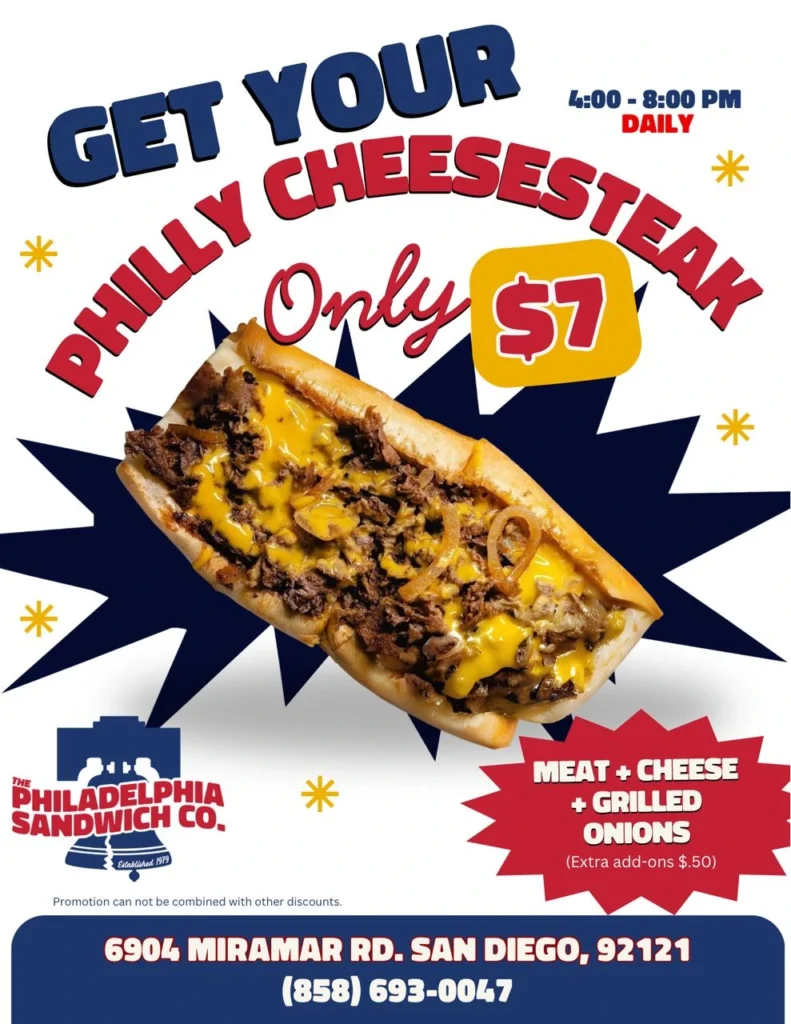
Order authentic Philly Cheesesteak with us! We offer catering & delivery! Please call: 858-693-0047 for orders!


A real Philadelphia cheesesteak is served on a long, soft Italian hoagie roll — most famously an Amoroso roll. The bread should have a thin, lightly crisp exterior and a soft, elastic interior that can hold hot ribeye steak and melted cheese without tearing or becoming soggy.
That is the short answer.
The longer answer is far more interesting — because the roll is not just bread. It is the engineering that makes the sandwich possible.
When most people think about a Philly cheesesteak, they immediately picture thinly sliced ribeye sizzling on a flat-top grill, melted cheese folding into chopped beef, and onions caramelizing beside it. Very few people start the conversation with bread. And yet, anyone who has eaten a cheesesteak in Philadelphia knows that the roll is just as important as the meat.
Without the correct roll, even perfectly cooked steak cannot deliver an authentic experience. The bread determines structure, bite resistance, moisture control, and overall balance. It dictates whether the sandwich feels cohesive or chaotic. It determines whether juices are absorbed or leak out. It decides whether each bite contains harmony — or collapse.
The roll is not background. It is architecture.
At Philadelphia Sandwich Co in San Diego, we treat the roll as a foundational component rather than an afterthought. Because when the bread is wrong, nothing else can correct it.
A cheesesteak is not a dry sandwich. It is a hot, high-moisture build. Ribeye releases rendered fat and natural beef juices as it cooks. Melted cheese spreads and binds to the chopped meat. Grilled onions contribute additional moisture and sweetness. All of this happens inside a narrow bread structure that must withstand heat, weight, and saturation.
If the bread is too soft, the bottom tears halfway through eating. If it is too crusty, it cracks and disrupts the balance of the filling. If it is too dense, it competes with the steak and makes the sandwich feel heavy.
The correct roll bends slightly when held. It compresses gently when bitten. It absorbs flavor without collapsing. It remains flexible under pressure.
That balance is not accidental. It is the product of very specific baking characteristics that evolved alongside the cheesesteak itself.
The authentic cheesesteak roll is an Italian-style hoagie roll typically between 8 and 12 inches long. It is not a baguette. It is not ciabatta. It is not a thick-crusted artisan loaf. It is a purpose-built sandwich roll designed to cradle hot beef and cheese.
The crust is thin and lightly crisp — just enough to create slight resistance without crunch. The interior crumb is soft, evenly textured, and slightly elastic. It should never feel dense or overly airy with large holes. The texture must be consistent from end to end.
Flavor matters as well. The bread should be neutral with only a faint hint of sweetness. It must not compete with the ribeye. The purpose of the roll is to frame the beef, not overshadow it.
This neutrality is intentional. Authentic cheesesteak rolls are made with relatively simple ingredients: bread flour, water, yeast, and salt. The emphasis is on structure rather than complexity.
In Philadelphia, one bakery became inseparable from cheesesteak culture: Amoroso’s Baking Company.
Founded in the early 20th century, Amoroso began supplying rolls to sandwich shops across the city. Over time, their bread became deeply embedded in what locals consider authentic.
Amoroso rolls achieve the exact balance cheesesteaks require. They are soft yet resilient. Light yet sturdy. Flexible yet structured. Their crust is thin and pliable rather than thick and crunchy. Their interior is evenly textured, allowing moisture to disperse rather than pool.
For many purists, a cheesesteak served without an Amoroso roll feels incomplete — even if the steak itself is properly prepared.
Outside of Philadelphia, similar Italian hoagie rolls are used to replicate this structure. The goal remains identical: softness with strength.
The effectiveness of a cheesesteak roll comes down to gluten development and moisture distribution.
Bread flour contains higher protein content than all-purpose flour. When kneaded, those proteins develop into gluten — a network that provides elasticity and structure. That elasticity allows the bread to stretch slightly rather than tear under pressure.
During baking, high heat creates a thin crust while preserving interior softness. The crumb structure remains tight and consistent rather than open and hole-filled like ciabatta or baguette. This tighter crumb allows beef juices to be absorbed evenly across the surface.
In contrast, artisan breads with large air pockets allow moisture to pool in uneven pockets, which can compromise structure.
In simple terms, cheesesteak rolls are engineered for the sandwich.
Many people assume that toasting improves sandwiches. In cheesesteaks, that assumption is only partially correct.
Traditional preparation leans toward gentle warming rather than aggressive toasting. The roll may touch the flat-top briefly to warm the exterior, but the interior remains soft. Over-toasting introduces rigidity. The bread becomes brittle and loses its ability to flex around the filling.
The cheesesteak experience relies on slight compression. The sandwich should feel warm and cohesive, not crunchy and resistant.
Proper warming enhances texture without compromising flexibility.
French bread may look similar in shape, but it behaves very differently.
Baguettes have thick crusts and stronger chew. They are designed for crisp bite, not compression. When used for cheesesteaks, they can crack and cause fillings to shift. Their larger interior holes create inconsistent moisture absorption.
The result feels different. The bite is sharper. The filling may separate from the bread rather than integrate.
While these breads can function as substitutes, they do not replicate the soft-cohesive structure of a traditional Philly roll.
One of the least discussed but most important aspects of cheesesteak authenticity is proportion.
There must be enough bread to hold the filling securely, but not so much that it dilutes flavor. If the roll is too thick, each bite becomes bread-dominant. If too thin, structural failure becomes likely.
The ideal ratio ensures that steak, cheese, and bread are experienced together in balanced harmony.
This balance is subtle — but essential.
If you have ever eaten a cheesesteak that collapses halfway through, the issue almost always traces back to the roll.
Common problems include overly soft supermarket sub rolls, bread that is too thin, insufficient warming, or excessive moisture paired with weak structure.
Authentic rolls are built to absorb without surrendering.
When the bread fails, the sandwich fails.
| Feature | Traditional Philly Roll | Modern / Alternative Roll |
|---|---|---|
| Crust | Thin, flexible, lightly crisp | Thick, crunchy, heavily toasted |
| Interior | Soft, elastic, evenly textured | Dense, holey, artisan-style |
| Moisture Control | Absorbs evenly without collapse | May crack or become soggy |
| Authenticity | Philadelphia standard | Regional reinterpretation |
At Philadelphia Sandwich Co in San Diego, located near Miramar Road, we serve guests from Sorrento Valley, La Jolla, Carmel Valley, Torrey Pines, Mira Mesa, University City, Del Mar, and Rancho Peñasquitos who expect an authentic East Coast experience.
That authenticity begins with proper ribeye. It continues with high-heat flat-top technique. And it depends entirely on selecting the correct roll structure.
Because when the roll is right, everything works.
The roll used for a real Philly cheesesteak is a long, soft Italian hoagie roll — most famously an Amoroso roll. It should be slightly crisp on the outside, soft and elastic on the inside, and sturdy enough to hold hot ribeye and melted cheese without collapsing.
The roll is not optional detail. It is the backbone of the sandwich.
When it’s right, the cheesesteak feels balanced, cohesive, and unmistakably Philadelphia.