Order authentic Philly Cheesesteak with us! We offer catering & delivery! Please call: 858-693-0047 for orders!
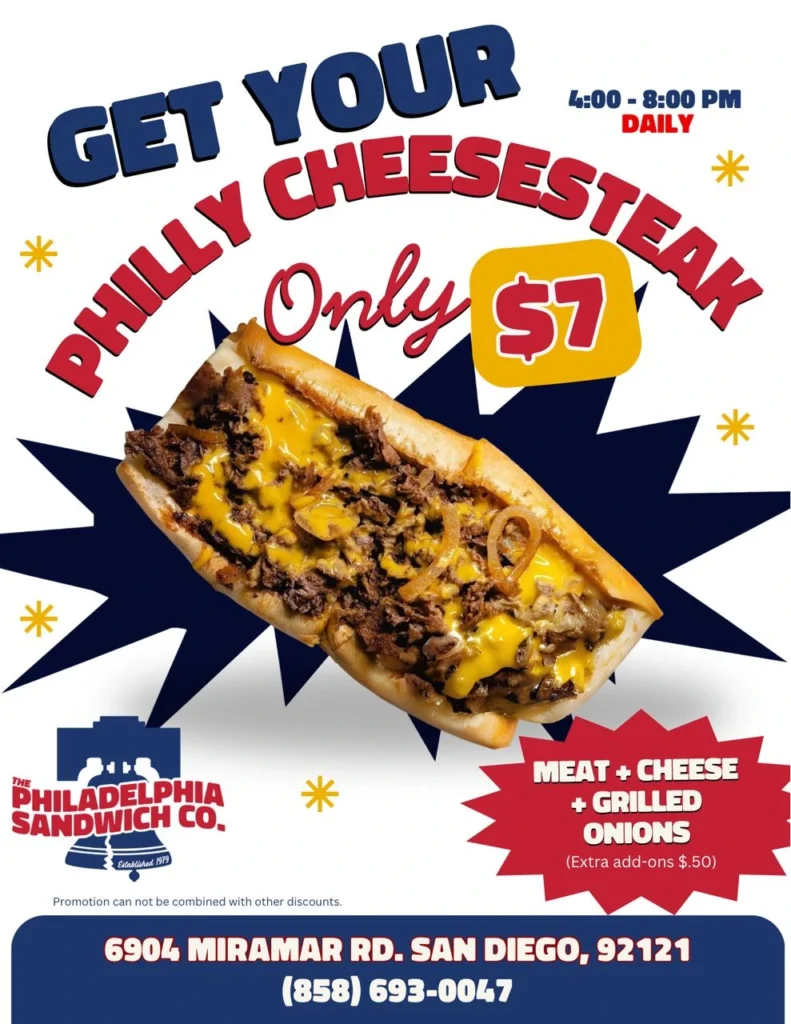
Monday - Saturday 4-8pm $7 cheesesteaks view
Details


An 8-inch cheesesteak contains approximately 600 to 900 calories, depending on the amount of ribeye, cheese selection, and preparation method.
A 6-inch cheesesteak typically ranges from 450 to 650 calories, while a 12-inch version can contain 900 to 1,200+ calories, especially with double meat or extra cheese.
If you’re tracking calories, macros, or simply want to know what to expect before ordering, the details below explain exactly where those calories come from and why totals vary.
A traditional Philadelphia cheesesteak is made with thinly sliced ribeye steak grilled on a flat-top, topped with melted cheese and often grilled onions, then served on a sturdy hoagie roll. Originating in Philadelphia, the sandwich has become one of America’s most recognizable and satisfying hot sandwiches.
The defining features are simplicity and balance: tender beef, melted cheese, and bread structured enough to hold heat and moisture without falling apart.
At Philadelphia Sandwich Co in San Diego, our cheesesteaks are prepared fresh using real ribeye and authentic East Coast technique. Located near Miramar Road, we serve guests from Sorrento Valley, La Jolla, Carmel Valley, Torrey Pines, Mira Mesa, University City, Del Mar, and Rancho Peñasquitos. Because every sandwich is made to order, portion size and customization directly influence the final calorie count.
A cheesesteak’s calorie total is primarily determined by three components: the steak, the cheese, and the roll. Each contributes differently to the overall macronutrient profile.
Ribeye is traditionally used because of its tenderness and flavor. A 6 to 8 ounce portion typically contributes between 350 and 500 calories. The reason ribeye is higher in calories than leaner cuts is its marbling — small streaks of fat distributed within the muscle.
Marbling increases flavor and juiciness, but it also increases calorie density. However, ribeye also delivers high-quality complete protein, iron, zinc, and B vitamins. It supports muscle repair, red blood cell production, and metabolic function.
This is why a cheesesteak is not simply “high calorie.” It is protein-dense and nutrient-dense, alongside being calorie-dense.
Cheese selection meaningfully shifts calorie totals.
While cheese contributes saturated fat and sodium, it also provides protein and calcium. The overall calorie impact depends more on quantity than brand.
The hoagie roll contributes roughly 200–300 calories, primarily from carbohydrates. Because authentic cheesesteaks use a dense roll that can withstand heat and moisture, it contains more structure and calories than typical sliced sandwich bread.
Carbohydrates provide immediate energy, which is part of why a cheesesteak feels satisfying and filling.
Cooking oil, butter on the grill, mayonnaise-based sauces, or extra steak portions can quickly increase calorie totals. Double meat or double cheese can push a sandwich well beyond 1,200 calories.
Even small additions accumulate quickly in high-density foods.
To understand cheesesteak calories, it helps to understand calorie density.
Calorie density refers to the number of calories in a given weight of food. Foods high in fat contain more calories per gram than foods high in carbohydrates or protein. Fat contains 9 calories per gram, while protein and carbohydrates each contain 4 calories per gram.
Because ribeye contains natural fat and cheese adds additional fat, cheesesteaks have a higher calorie density than lean poultry sandwiches. The hoagie roll adds carbohydrates, increasing total energy without adding significant bulk.
This combination of fat, protein, and carbohydrates makes cheesesteaks highly satisfying. Calorie-dense foods are not inherently unhealthy — they simply provide more energy in smaller portions.
The key is frequency and portion size.
Below is a general comparison for traditional ribeye cheesesteaks:
| Size | Calories | Protein | Fat | Carbs |
|---|---|---|---|---|
| 6-inch | 450–650 | 25–35g | 20–30g | 35–45g |
| 8-inch | 600–900 | 35–45g | 30–45g | 45–60g |
| 12-inch | 900–1,200+ | 50–70g | 45–65g | 70–90g |
These numbers vary slightly by restaurant and portioning, but they reflect common ranges for authentic ribeye-based cheesesteaks.
Many people are surprised to see calorie estimates differ across restaurants. Several factors explain this variation.
First, portion size differs significantly. One restaurant’s “8-inch” sandwich may contain more steak than another’s. Second, steak trimming levels matter. Ribeye can be slightly leaner or more heavily marbled depending on sourcing. Third, cheese portioning varies — some establishments apply a light layer while others use multiple slices or heavy sauce.
Additionally, roll size and density differ by bakery supplier. Even cooking oil usage on the grill can influence totals.
Because cheesesteaks are often made fresh rather than pre-packaged, minor differences in preparation can shift calorie numbers by 50 to 200 calories.
Searches for “cheesesteak calories with whiz” are common.
Generally, the difference between cheese sauce and provolone is modest — usually within 50 to 120 calories depending on portion size. The larger calorie variable is typically the amount of steak used.
If total calorie intake is a concern, reducing meat quantity has a larger impact than switching cheese type alone.
An 8-inch cheesesteak typically provides 35 to 45 grams of protein. This is substantial for a single sandwich and can account for a significant portion of daily protein needs for many adults.
Fat content usually ranges from 30 to 45 grams in an 8-inch sandwich, largely from ribeye marbling and cheese. While saturated fat should be consumed in moderation, dietary fat increases satiety and flavor.
Carbohydrates generally fall between 45 and 60 grams, primarily from the roll. This carbohydrate content supplies energy, especially helpful for physically active individuals.
In many cases, yes. A standard fast-food burger typically ranges from 500 to 700 calories. An 8-inch cheesesteak often exceeds that range.
However, cheesesteaks often contain more protein and iron than typical burgers. The nutritional comparison depends on portion size and preparation method.
Calorie count alone does not determine nutritional value.
Yes — context matters.
When enjoyed occasionally and balanced within total daily intake, a cheesesteak can fit into many dietary patterns. Portion control is the most effective strategy. Choosing a 6-inch version, sharing a larger sandwich, or skipping calorie-dense sides like fries can meaningfully reduce total intake.
For individuals focused on muscle gain, a cheesesteak’s protein density may align with higher caloric needs. For those managing weight, moderation and meal planning are key.
Small adjustments can meaningfully lower calorie totals.
Selecting a smaller size is the simplest method. Requesting lighter cheese can reduce intake by 80 to 150 calories. Adding vegetables such as peppers, mushrooms, or onions increases volume and fiber without substantially increasing calories.
Pairing your sandwich with water instead of soda and avoiding high-calorie sides helps maintain balance.
Because cheesesteaks at Philadelphia Sandwich Co in San Diego are prepared fresh to order, customization is straightforward.
Cheesesteaks can contain moderate to high sodium due to cheese and seasoning. Individuals monitoring sodium intake may benefit from limiting extra cheese or salty condiments.
Balancing sodium throughout the day is often more practical than avoiding specific foods entirely.
Philadelphia Sandwich Co brings authentic East Coast–style cheesesteaks to San Diego using real ribeye grilled fresh on a flat-top. Located near Miramar Road, we serve guests from Sorrento Valley, La Jolla, Carmel Valley, Torrey Pines, Mira Mesa, University City, Del Mar, and Rancho Peñasquitos.
Guests often search for “cheesesteak calories in San Diego” or “philly cheesesteak nutrition facts near me” before visiting. Our team is always happy to answer ingredient and portion questions so you can order confidently.
In addition to serving individual guests, Philadelphia Sandwich Co offers cheesesteak catering throughout North County and coastal San Diego. Office lunches in Sorrento Valley, corporate meetings in University City, and private events near Torrey Pines frequently feature our ribeye cheesesteaks prepared fresh and delivered hot.
Because we are centrally located, we can efficiently serve surrounding communities while maintaining quality from grill to event.
An 8-inch cheesesteak with cheese sauce typically contains between 700 and 950 calories depending on portion size.
Most 8-inch cheesesteaks contain 35 to 45 grams of protein.
An 8-inch version usually contains 45 to 60 grams of carbohydrates, primarily from the hoagie roll.
Because it is high in protein and calories, it can support caloric surplus goals when consumed strategically.
Portion size and total daily intake matter more than individual foods. A smaller portion can fit into many balanced dietary plans.
Differences in steak portion, cheese quantity, roll size, and cooking method all influence total calories.
Often yes, especially if the chicken sandwich uses lean grilled breast meat. However, preparation style determines the final total.
A cheesesteak is calorie-dense, protein-rich, and highly satisfying. An 8-inch sandwich typically contains 600 to 900 calories, while larger portions can exceed 1,000 calories depending on customization.
Understanding how ribeye marbling, cheese selection, roll density, and portion size contribute to total calories allows you to make informed decisions. When enjoyed occasionally and balanced within overall intake, a cheesesteak can fit comfortably into a realistic eating pattern.
If you have questions about ingredients, portion sizes, or catering in San Diego, the team at Philadelphia Sandwich Co is always ready to help you enjoy authentically — and eat informed.