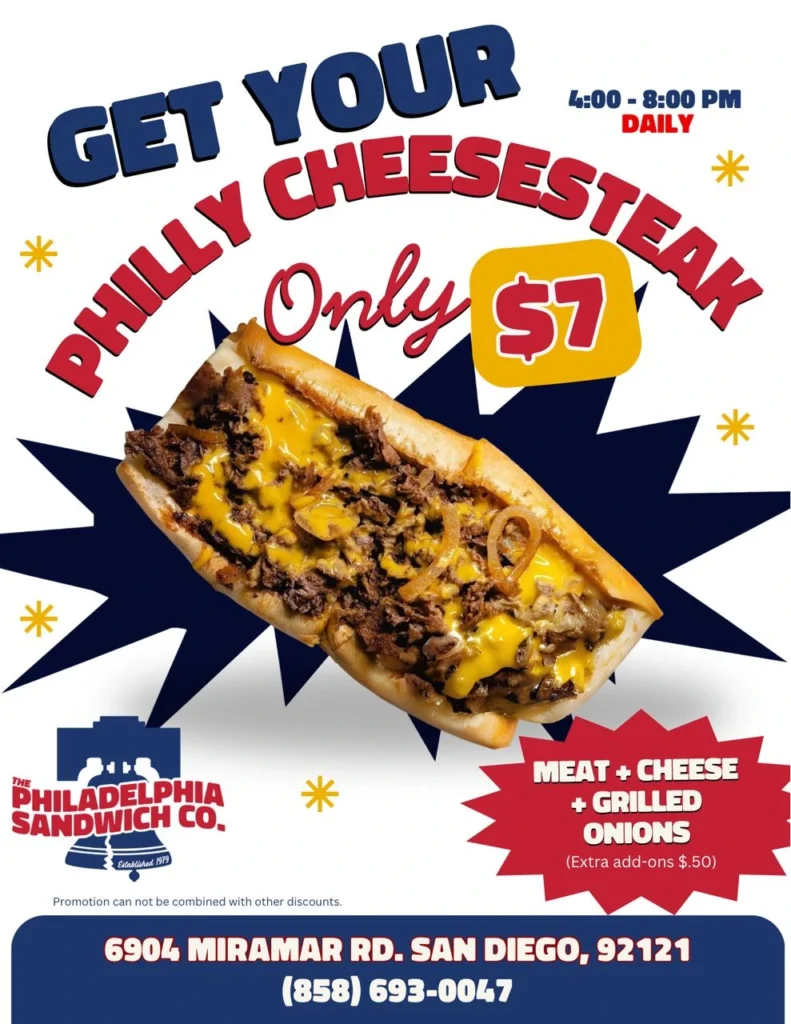
Order authentic Philly Cheesesteak with us! We offer catering & delivery! Please call: 858-693-0047 for orders!


Thin sliced ribeye steak is the traditional cut used for authentic Philly cheesesteaks because its intramuscular marbling renders under high heat, keeping the chopped meat tender, juicy, and cohesive. Sliced thin across the grain and cooked quickly on a hot flat top, ribeye browns properly, integrates smoothly with melted cheese, and delivers the balanced richness that defines the sandwich.
A proper cheesesteak is built like a system. High heat creates browning. Ribeye’s internal fat renders to lubricate chopped strands. Cheese melts into the meat to bind the filling. The roll compresses around everything to hold the structure together. Ribeye is the cut that behaves correctly under that pressure, which is why it remains the standard in long-standing Philadelphia shops.
A proper Philly cheesesteak begins and ends with ribeye. Not sirloin. Not top round. Not pre-formed shaved steak of uncertain origin. Ribeye performs correctly under the conditions a cheesesteak demands: high heat, rapid cooking, and chopping with steel spatulas.
When you bite into a well-made cheesesteak, the meat should feel tender but cohesive. It should not crumble like ground beef and it should not pull into long chewy strands. That balance is ribeye doing its job.
Thin sliced ribeye for a Philly cheesesteak is not shaved deli meat and it is not thick steak strips. It sits in the functional middle: thin enough to cook in seconds, thick enough to brown without drying out.
A practical benchmark is about 1/8 inch thick or slightly thinner. Each slice should drape naturally, fold easily, and cook quickly once it hits the flat top. If slices are too thick, they resist fast cooking and can become chewy before the interior finishes. If slices are too thin, they lose moisture quickly and struggle to brown properly.
Thin slicing is about speed and control. Cheesesteaks are fast by design, and the cut has to support that pace.
Proper slicing begins before the knife touches the meat. Place the ribeye in the freezer for about 30 to 45 minutes. The goal is to firm it slightly, not freeze it solid. That firmness lets you create clean, even slices without compressing the meat.
Slice across the grain. Cutting across the grain shortens muscle fibers, which improves tenderness once the meat is cooked and chopped. Slicing with the grain creates long fibers that can become chewy and pull out of the sandwich during eating.
Keep thickness consistent. Uneven slices cook unevenly, which affects both moisture retention and texture.
If purchasing pre-sliced ribeye, look for visible marbling throughout the slices and consistent thickness. Avoid overly lean packages labeled generically as “sandwich steak,” which often come from cheaper cuts that lack internal fat and do not behave the same way on the grill.
Heat is everything. A flat top or griddle must be fully preheated before the meat touches the surface. When thin sliced ribeye hits hot steel, it should sizzle instantly. That sound signals moisture is evaporating quickly and browning is beginning.
Spread the slices briefly so they make contact with the surface, then leave them undisturbed for 20 to 30 seconds. During that moment, the edges tighten slightly and the underside develops color. The aroma shifts from raw beef to savory browning.
Only after that first layer of browning forms should chopping begin. Use two spatulas and chop in controlled motions to shorten the slices into manageable strands. The goal is not to pulverize the meat into fragments. The goal is to reduce fiber length so the sandwich bites cleanly without long strands pulling out of the roll.
As you chop and turn, ribeye’s rendered fat coats the meat naturally. The texture remains moist and slightly glossy. The entire process should take only a few minutes. Overcooking is the fastest way to lose ribeye’s advantage, so high heat and short exposure matter.
Leaner cuts like sirloin or top round lack the marbling needed to remain tender after chopping. They can brown initially, but they dry out quickly and feel less cohesive once fully cooked. Even if oil is added, the fat is external rather than woven through the muscle, so the texture still feels different.
Ribeye also supports cheese integration better. When cheese melts into ribeye, rendered fat helps bind the mixture into a cohesive filling. With leaner cuts, the meat and cheese can feel more separate, and the bite becomes less unified.
Because ribeye carries its own richness, seasoning can remain restrained. Salt is often sufficient when browning is done correctly. Heavy seasoning blends are more common when the meat itself is not providing the right depth.
Once the ribeye is chopped and lightly browned, gather it into a compact mound on the flat top. Lay slices of white American or provolone directly over the top, or apply warmed Cheese Whiz.
Allow the cheese to soften from the heat of the meat, then fold the chopped ribeye inward and press gently so the cheese melts into the beef rather than sitting as a separate layer. The mixture should become cohesive and slightly glossy.
This is one of the reasons thin slicing matters. Thick strips resist folding and do not integrate as smoothly. Lean meat does not bind as naturally because it lacks the rendered fat that supports cohesion.
Cooking at too low a temperature causes the meat to steam instead of sear, which produces gray, bland beef.
Overcrowding the griddle traps moisture and prevents browning.
Over-chopping breaks the meat down into dry, crumbly bits that resemble ground beef.
Using lean cuts eliminates the natural lubrication that ribeye provides, making the filling feel dry and less cohesive.
Each mistake interrupts the system that makes a cheesesteak work: high heat, controlled fat, quick cooking, and integrated cheese.
Look for consistent marbling throughout the muscle rather than fat concentrated only at the edges. Internal streaks of fat are what matter most for cheesesteak performance.
Avoid overly trimmed cuts that remove too much internal fat. Ribeye should feel firm but flexible when pressed lightly. If slicing yourself, buying a whole ribeye allows you to control thickness. If buying pre-sliced, inspect for uniform thickness and freshness so the meat cooks evenly on a flat top.
Proper handling from purchase to slicing to cooking preserves the texture and flavor that define the sandwich.
For over 40 years, The Philadelphia Sandwich Co. has prepared cheesesteaks using thin-sliced ribeye cooked on a hot flat top, classic cheese melted directly into the meat, and authentic Amoroso rolls that provide the proper structure and bite.
When ribeye is sliced properly and handled with disciplined heat control, the sandwich carries its own richness without shortcuts or substitutions. That commitment to traditional technique continues at our Miramar Road location in San Diego.
The Philadelphia Sandwich Co.
6904 Miramar Rd. Suite 207
San Diego, CA 92121
Phone: (858) 693-0047