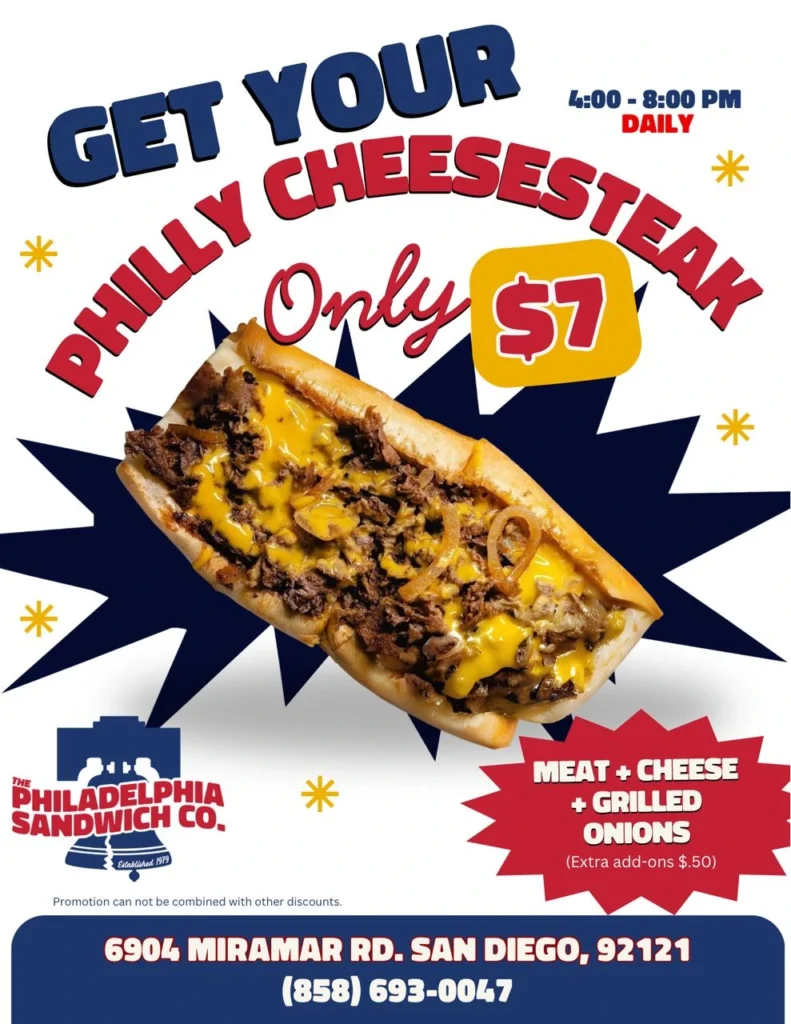
Order authentic Philly Cheesesteak with us! We offer catering & delivery! Please call: 858-693-0047 for orders!


An authentic Philly cheesesteak is made with thinly sliced ribeye steak cooked on a hot flat-top grill, topped with provolone, American cheese, or Cheez Whiz, served on a soft Italian hoagie roll, and optionally finished with grilled onions. It uses simple seasoning—typically salt and black pepper—and avoids marinades, heavy sauces, lettuce, tomato, or gourmet additions. Authenticity is defined by ingredient restraint, proper technique, and respect for its Philadelphia origins.
Anything beyond that becomes a variation.
The Philly cheesesteak was born in South Philadelphia in the early 1930s when hot dog vendor Pat Olivieri decided to grill thin slices of beef on his cart instead of sausages. A passing taxi driver asked for one, and the sandwich quickly gained local popularity. What began as steak and onions on a roll soon became a defining part of the city’s food culture.
The original version did not include cheese. That addition came later. In the 1940s, provolone was introduced, adding richness and helping bind the chopped steak together. In the 1950s, Cheez Whiz entered the picture and became deeply embedded in South Philly cheesesteak culture. American cheese later joined the accepted trio.
What makes this origin story important is its simplicity. The cheesesteak was never meant to be elaborate. It was affordable, quick, and satisfying — a reflection of working-class neighborhoods and practical cooking. Its power came from execution, not complexity.
Authenticity begins by honoring that simplicity.
A real Philly cheesesteak follows clear structural rules. These are not marketing claims or restaurant gimmicks. They are boundaries shaped over decades of repetition and cultural preservation.
When those boundaries are respected, the sandwich remains authentic. When they are ignored, the sandwich becomes something else.
Ribeye is essential because of marbling — the thin streaks of intramuscular fat running through the muscle. When ribeye hits a hot flat-top grill, that fat renders quickly and coats the meat fibers, creating natural juiciness and tenderness.
High heat triggers the Maillard reaction, producing the browned, savory compounds that define cheesesteak flavor. Because ribeye already contains built-in richness, it does not require marinades, soy sauce, sugar glazes, or spice rubs. If the meat is heavily seasoned or soaked in marinade, the sandwich has drifted from tradition.
Thin slicing is equally critical. The steak must be shaved paper-thin so it cooks rapidly and integrates smoothly with melted cheese. Thick strips produce a steak sandwich, not a cheesesteak.
Authentic cheesesteaks are beef-forward.
There are only three cheeses recognized as traditional:
Provolone
American
Cheez Whiz
Provolone provides mild tang and dairy balance while keeping beef dominant. American cheese melts smoothly and integrates evenly into chopped steak. Cheez Whiz delivers bold, creamy, salt-forward richness that many associate with iconic South Philly shops.
Swiss, cheddar, pepper jack, mozzarella, and gourmet blends may taste good — but they are not traditional Philly cheesesteak cheeses.
Authenticity respects historical boundaries.
Bread is not a secondary detail. It is structural engineering.
An authentic cheesesteak uses a soft Italian hoagie roll with a light exterior crust and a tender interior crumb. The roll must absorb beef juices without tearing and compress slightly when held, allowing the sandwich to be eaten comfortably.
Overly crusty baguettes crack and disrupt the bite. Thin sandwich bread collapses. Brioche adds sweetness that shifts the flavor profile away from tradition.
The roll should support the steak and cheese without overpowering them.
Balance between softness and strength defines authenticity.
In Philadelphia, you order your cheesesteak “wit” (with onions) or “witout” (without onions). Onions are sautéed directly on the same flat-top grill as the steak, absorbing rendered beef fat and becoming savory rather than sweet.
They are softened, not caramelized into sugary jam. Their purpose is balance, not dominance.
Bell peppers, though common outside Philadelphia, were not part of the original formula. They are optional additions, not defining ingredients.
Authenticity allows onions. It does not require peppers.
The cheesesteak is built on the grill — not assembled like a deli sandwich.
The steak is spread across a hot flat-top surface, chopped and folded repeatedly as it browns. Cheese is placed directly onto the hot meat so it melts into the chopped ribeye before being transferred to the roll. This creates cohesion and integration.
If meat and cheese are combined separately or assembled cold, the sandwich loses its defining texture.
Technique matters as much as ingredients.
Many sandwiches labeled “Philly cheesesteak” deviate from tradition. Understanding these differences helps clarify authenticity.
| Element | Authentic Cheesesteak | Common “Philly-Style” Version |
|---|---|---|
| Meat | Thin-sliced ribeye | Sirloin, roast beef, shaved steak blends |
| Cheese | Provolone, American, or Whiz | Cheddar, Swiss, gourmet blends |
| Roll | Soft hoagie roll | Baguette, brioche, crusty artisan bread |
| Seasoning | Salt & black pepper | Marinades, soy sauce, spice rubs |
| Assembly | Built on flat-top grill | Deli-style assembly or oven-baked |
These alternatives may be flavorful, but they represent reinterpretations. Authenticity depends on discipline and restraint.
Ribeye’s fat content naturally enhances tenderness and flavor perception. Salt amplifies existing glutamates in beef, intensifying savoriness without masking the meat. High heat produces browning compounds that deliver depth.
Heavy spice blends compete with beef. Marinades alter texture. Excess toppings dilute structural balance.
The cheesesteak works because it amplifies what already exists in the meat. It does not attempt to reinvent it.
Working-class food historically relied on clarity, not embellishment. The cheesesteak is proof that fewer ingredients, when executed correctly, create stronger identity.
In Philadelphia, the cheesesteak carries its own language.
“Whiz wit” means Cheez Whiz with onions.
“Provolone witout” means provolone without onions.
The shorthand reflects familiarity. The sandwich is often eaten standing at a counter, wrapped in paper, without ceremony. It represents neighborhood pride and generational continuity.
To prepare an authentic cheesesteak is to respect that culture.
Yes — if the same principles are followed.
Authenticity is not limited by geography. It is defined by adherence to ingredient integrity and cooking method.
At Philadelphia Sandwich Co on Miramar Road in San Diego, our cheesesteaks are prepared using thin-sliced ribeye, balanced seasoning, high-heat flat-top cooking, traditional cheese options, and soft hoagie rolls. While located outside Pennsylvania, the preparation philosophy remains rooted in East Coast tradition.
Authenticity travels with the method.
Even experienced cooks shift away from tradition when they:
Use deli roast beef
Over-season with spice blends
Add lettuce and tomato (creating a cheesesteak hoagie)
Choose crusty baguettes
Cook at low heat
Marinate the steak
Each of these changes texture, moisture balance, or flavor hierarchy.
The authentic cheesesteak is defined by precision, not creativity.
No. Cheez Whiz is traditional and culturally significant, but provolone and American cheese are equally authentic.
Bell peppers are common additions outside Philadelphia but were not part of the original cheesesteak formula.
Thinly sliced ribeye steak is the traditional and widely accepted cut.
Chicken cheesesteaks are popular variations but are not the original version.
Traditional cheesesteak meat is not marinated. Ribeye provides natural tenderness and flavor.
An authentic Philly cheesesteak is defined by:
Thin-sliced ribeye cooked quickly on a flat-top grill
Provolone, American, or Cheez Whiz
A soft hoagie roll
Optional grilled onions
Simple salt and pepper seasoning
No marinades or heavy toppings
Authenticity is not about adding more. It is about honoring the original formula through discipline and respect.
When executed properly, the result is not just a sandwich. It is a preserved piece of American culinary history — one that has endured precisely because it resists reinvention.